

2. Understanding the Models: Staff Augmentation, Nearshore Development, and Traditional Outsourcing
Before comparing nearshore staff augmentation with traditional outsourcing, it is important to understand what each model actually means.
Although these terms are frequently used interchangeably, they describe different aspects of how companies organize, manage, and deliver software development projects.
The distinction matters because choosing the right engagement model affects much more than the price of development. It determines who manages the engineers, how technical decisions are made, how quickly teams respond to changes, and who is ultimately accountable for delivering the software.
What Is Specialized Staff Augmentation?
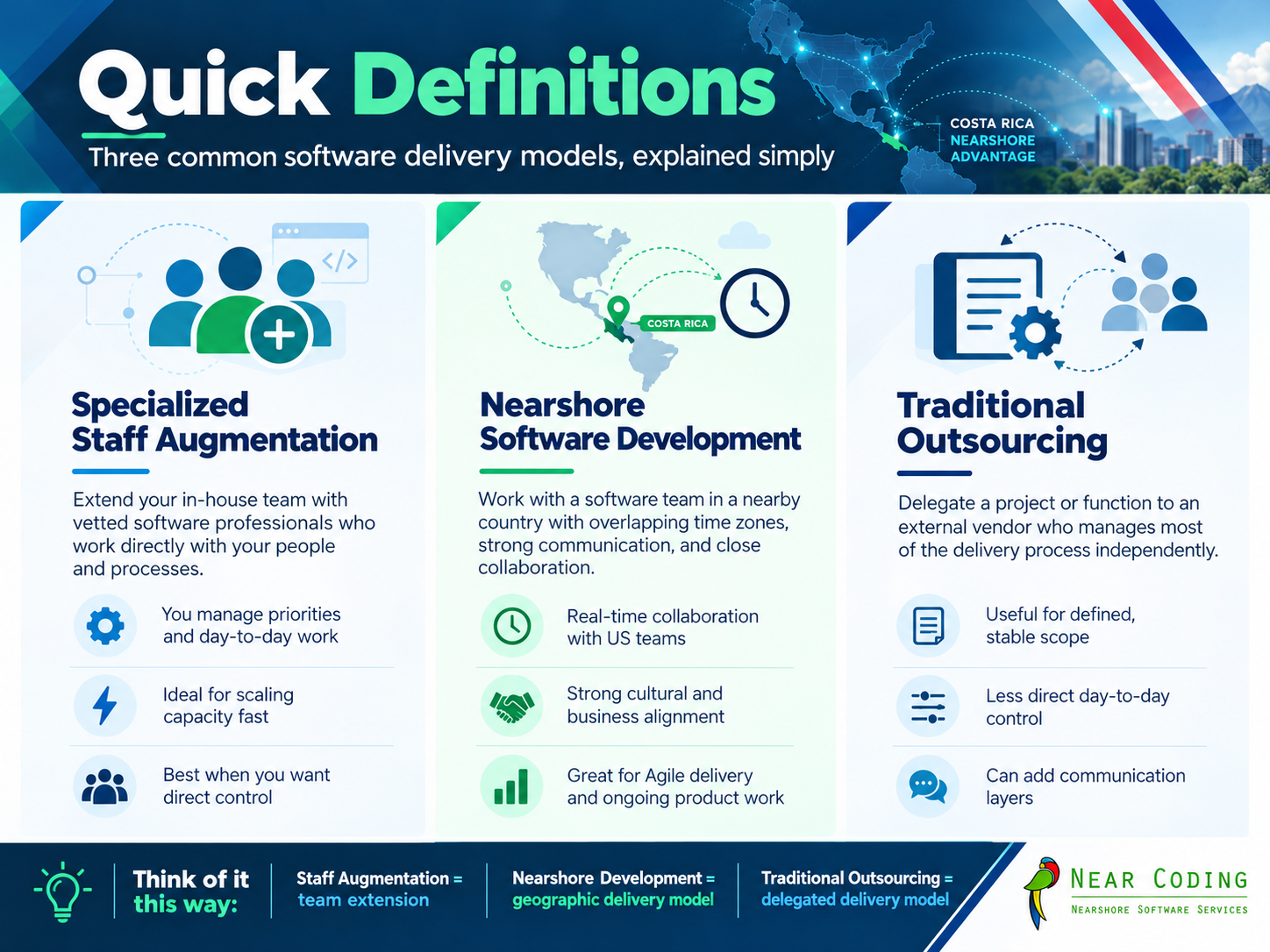
Specialized staff augmentation is a collaboration model that allows companies to extend their existing development teams with external software professionals who work directly alongside their internal employees.
Rather than outsourcing an entire project, the company brings in professionals with specific technical skills to strengthen its existing capabilities.
These professionals might include senior software developers, software architects, QA automation engineers, DevOps specialists, database experts, or technical leads.
For example, imagine a US-based company maintaining a large enterprise application built with C#, ASP.NET Core, SQL Server, and React.
Its internal development team understands the business, owns the software architecture, and manages the product roadmap. However, the company needs three additional senior engineers to accelerate development and address a growing backlog.
Instead of hiring permanent employees or transferring the project to an external vendor, the company partners with a specialized staff augmentation provider.
The additional engineers join the existing team, participate in sprint planning, attend daily standups, review code, work within the same repositories, and follow the organization’s development standards.
The company retains control over priorities, architecture, and delivery, while the provider handles responsibilities such as recruiting, employment administration, and supporting the assigned professionals.
The main advantage is straightforward: companies gain specialized engineering capacity without surrendering control over their software development process.
This model is particularly valuable for businesses with established engineering leadership, evolving products, and long-term technical requirements.
What Are Dedicated Development Teams?
A dedicated development team is a group of software professionals assigned to work consistently on a particular client’s products or projects.
Unlike individual staff augmentation, which typically adds specific professionals to an existing team, a dedicated team can provide an entire development unit.
Depending on the client’s needs, that team may include:
Backend and frontend developers.
Software architects and technical leads.
QA engineers and automation specialists.
DevOps and cloud engineers.
Scrum Masters or technical project managers.
Dedicated teams can operate under the client’s technical leadership or follow a shared management model in which the software development partner assumes additional delivery responsibilities.
For example, a US SaaS company might establish a dedicated nearshore team responsible for developing new modules while its internal engineers focus on core platform architecture and strategic initiatives.
The advantage is continuity.
Over time, the dedicated team becomes familiar with the codebase, development standards, business requirements, and technical challenges. This accumulated knowledge can improve efficiency, reduce onboarding effort, and strengthen collaboration.
Dedicated development teams are particularly useful when a company needs sustained engineering capacity rather than temporary assistance for an isolated project.
What Is Nearshore Software Development?
Nearshore software development refers to working with software professionals or development companies located in geographically nearby countries, typically with compatible or overlapping business hours.
For US companies, nearshore software services commonly involve working with development teams across Latin America, including countries such as Costa Rica, Mexico, Colombia, and others.
The primary benefit is not simply geographic proximity. It is the opportunity to maintain close collaboration across locations without the scheduling difficulties often associated with distant offshore teams.
Consider a development team located in Costa Rica.
Costa Rica operates on Central Standard Time (UTC−6) year-round, creating substantial working-hour overlap with US companies across multiple time zones.
This makes it easier for developers, product owners, engineering managers, and business stakeholders to participate in the same meetings, clarify requirements during the workday, address blockers, and coordinate releases.
For Agile teams, this alignment can be especially valuable.
A developer who encounters an unexpected integration issue in the morning can discuss it with the client’s technical lead that same day rather than waiting until the next working cycle.
However, nearshore development is not a separate management model.
A nearshore software development partner can provide specialized staff augmentation, dedicated development teams, or complete custom software development services.
In other words, nearshore describes where the development team operates, not necessarily how the engagement is managed.
For US organizations seeking both technical expertise and close collaboration, Costa Rica software development services can offer a practical combination of time zone alignment, bilingual professionals, and access to specialized engineering talent.
What Is Traditional Software Outsourcing?
Traditional software outsourcing generally refers to delegating responsibility for a software project, system, or business function to an external service provider.
In a typical project-based outsourcing arrangement, the client establishes its requirements, objectives, budget, and expected deliverables. The external vendor then organizes the team, manages development activities, and assumes responsibility for delivering the agreed scope.
For example, a company might hire a custom software development company to build an internal reporting application.
The client provides business requirements, approves the project scope, and participates in scheduled reviews. Meanwhile, the outsourcing provider manages the development team, technical implementation, testing, and delivery.
This approach can work very well when requirements are clear, project boundaries are well defined, and the client prefers to delegate day-to-day execution.
However, outsourcing becomes more challenging when the software is highly integrated with existing systems, depends on constant business feedback, or requires continuous changes in priorities.
Additional management layers, formal change requests, and limited direct interaction with developers can introduce delays if the engagement is not structured carefully.
It is also important to understand that traditional outsourcing does not automatically mean offshore development.
Outsourcing describes the delegation of responsibility, while offshore and nearshore describe the geographic location of the service provider.
A US company can outsource a project to a vendor in Costa Rica just as it can outsource one to a vendor in India or Eastern Europe.
The difference lies in the combination of location, collaboration practices, management responsibilities, and delivery expectations.
Understanding the Difference
The simplest way to distinguish these concepts is to think about three separate decisions:
1. Where should the developers work?
Nearshore, offshore, or onshore development addresses the geographic location of the team.
2. How should the company access engineering talent?
Specialized staff augmentation and dedicated development teams address how engineering capacity is organized and integrated into the business.
3. Who should manage delivery and technical execution?
Client-managed staff augmentation, jointly managed dedicated teams, and vendor-managed outsourcing establish different levels of operational responsibility.
These decisions are related, but they are not mutually exclusive.
A US company could employ a nearshore dedicated development team through a staff augmentation arrangement. Another company might hire a nearshore custom software development partner to take full responsibility for designing, developing, and delivering an application.
Both approaches involve nearshore software development, but they offer different levels of control, involvement, and accountability.
Understanding these distinctions is the first step toward choosing the model that best fits your company’s technical capabilities, business objectives, and long-term software strategy.